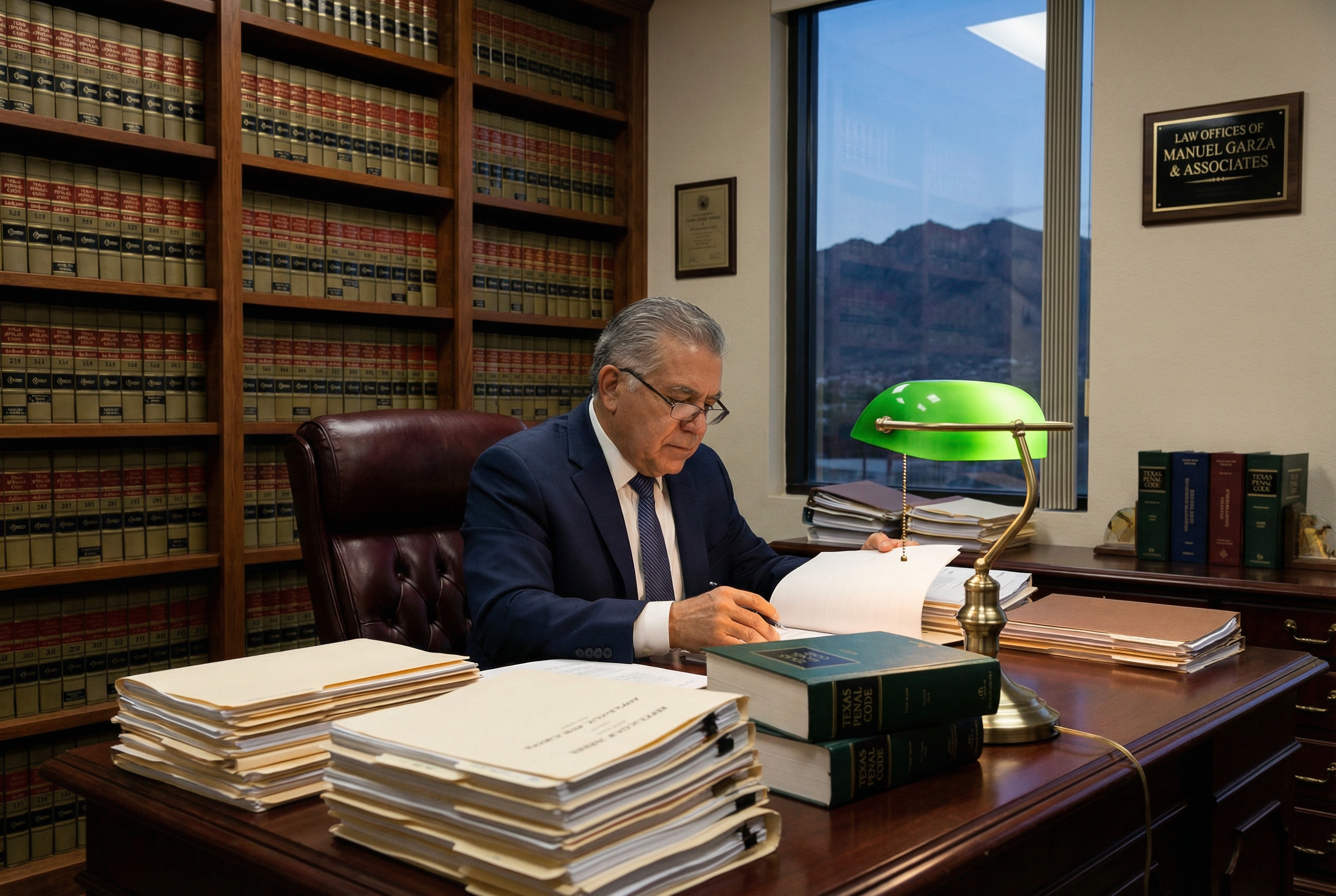
What Is Criminal Appeals & Post-Conviction Relief?
A criminal appeal is a formal request to a higher court to review a lower court's decision and correct legal errors that affected the outcome of the case. In El Paso, criminal convictions from County Courts at Law and District Courts are appealed to the Texas Eighth Court of Appeals, which sits at 500 E. San Antonio Ave. in downtown El Paso. The Eighth Court of Appeals has jurisdiction over criminal cases from El Paso, Brewster, Culberson, Hudspeth, Jeff Davis, Loving, Pecos, Presidio, Reeves, Ward, and Winkler counties. An appeal is not a new trial — the Court of Appeals does not hear new testimony or consider new evidence. Instead, it reviews the written record of the trial (the reporter's record and the clerk's record) and the written briefs filed by the attorneys to determine whether legal errors occurred and whether those errors were harmful enough to require a new trial, a reduced sentence, or an acquittal. There are several types of post-conviction relief available in Texas. A direct appeal is filed after sentencing and challenges errors that appear in the trial record — such as improper admission of evidence, incorrect jury instructions, prosecutorial misconduct, or insufficient evidence to support the verdict. A motion for new trial must be filed within 30 days of sentencing and can raise issues that are not in the trial record, such as newly discovered evidence or juror misconduct. A writ of habeas corpus under Texas Code of Criminal Procedure Article 11.07 (for felonies) or Article 11.09 (for misdemeanors) is a post-conviction remedy that can raise constitutional claims not raised on direct appeal — most commonly, ineffective assistance of trial counsel. Each of these remedies has strict deadlines and procedural requirements, and missing a deadline can permanently forfeit your right to relief.
Penalties in Texas — What You Are Facing
The stakes in a criminal appeal are as high as the original conviction. A successful appeal can result in a reversal of the conviction and a new trial, an acquittal if the evidence was legally insufficient to support the verdict, a reduction in sentence if the punishment was improperly assessed, or a remand for resentencing. A failed appeal, however, does not make your situation worse — the conviction and sentence remain as they were. In El Paso, criminal appeals are particularly important in cases involving Fort Bliss military personnel and Department of Defense employees, because a felony conviction results in automatic loss of security clearance and military career. For the thousands of El Paso residents who work in defense-related industries, an appeal that results in a new trial or acquittal can mean the difference between keeping a career and losing it permanently. For non-citizens in El Paso's large immigrant community, a criminal conviction triggers mandatory immigration consequences under federal law — including deportation, inadmissibility, and bars to naturalization. A successful appeal that vacates the conviction can eliminate these consequences. Even a reduction in the sentence — for example, from 365 days to 364 days — can make the difference between a conviction that triggers deportation and one that does not under the Immigration and Nationality Act. For DWI convictions in El Paso, a successful appeal can restore driving privileges, prevent the two-year driver's license surcharge under the Texas Driver Responsibility Program, and eliminate the mandatory ignition interlock requirement. For felony convictions, a successful appeal prevents the permanent loss of the right to vote, the right to possess firearms, and eligibility for professional licenses.
Don't face Criminal Appeals & Post-Conviction Relief charges alone in El Paso, TX.
Attorney Aaronson has 45+ years defending El Paso residents. Free consultation — no obligation.

The Legal Process in El Paso, Texas
The criminal appeals process in Texas follows a strict procedural timeline that begins the moment sentence is pronounced. Understanding each step is critical to preserving your appellate rights. The first and most urgent step is filing a Notice of Appeal within 30 days of sentencing (or within 90 days if a motion for new trial was timely filed). This single document — filed with the trial court clerk — preserves your right to appeal. Missing this deadline is almost always fatal to the appeal. Attorney Aaronson monitors sentencing dates closely and files notices of appeal immediately when retained. After the notice of appeal is filed, the court reporter prepares the reporter's record (the transcript of all trial proceedings) and the district clerk prepares the clerk's record (all documents filed in the case). These records are then transmitted to the Eighth Court of Appeals in El Paso. The appellant's brief — the written argument explaining the legal errors and why they require reversal — is typically due 30 days after the record is filed. The State then has 30 days to file its response brief, and the appellant may file a reply brief. The Eighth Court of Appeals may decide the case on the briefs alone, or it may schedule oral argument if the issues are complex or the court has questions. The court typically issues its opinion within six to twelve months of the briefs being filed, though complex cases can take longer. If the Eighth Court of Appeals denies relief, the case can be further appealed to the Texas Court of Criminal Appeals in Austin — the highest criminal court in Texas. For post-conviction writs of habeas corpus under Article 11.07, the application is filed in the trial court, which makes findings of fact and forwards the record to the Texas Court of Criminal Appeals for a final decision. This process typically takes one to two years.
Defense Strategies That Work in El Paso Courts
Identifying the strongest grounds for appeal requires a thorough review of the entire trial record — every ruling by the judge, every piece of evidence admitted or excluded, every instruction given to the jury, and every argument made by the prosecution. Attorney Aaronson reviews trial records with the same meticulous attention he brings to trial preparation, looking for the following categories of reversible error. Insufficiency of the evidence is one of the most powerful grounds for appeal. If the evidence presented at trial, viewed in the light most favorable to the verdict, was legally insufficient to prove every element of the offense beyond a reasonable doubt, the Court of Appeals must render an acquittal — not just a new trial. This is a complete victory. Improper admission or exclusion of evidence is the most common ground for appeal in El Paso criminal cases. If the trial judge admitted evidence that should have been excluded — such as illegally obtained evidence, hearsay that does not fall within a recognized exception, or unfairly prejudicial evidence under Texas Rule of Evidence 403 — and that error affected the outcome, the conviction can be reversed. Ineffective assistance of counsel under Strickland v. Washington is a constitutional claim that can be raised on direct appeal (if the record is sufficient) or in a habeas corpus writ. If trial counsel's performance fell below the objective standard of reasonableness and there is a reasonable probability that the outcome would have been different with competent representation, the conviction can be vacated. Prosecutorial misconduct — including improper jury arguments, failure to disclose exculpatory evidence under Brady v. Maryland, or use of false testimony — is a serious constitutional violation that can require reversal. Improper jury charge errors, including incorrect definitions of the offense elements or failure to include a requested defensive instruction, are also common grounds for reversal in Texas.
Why Choose Aaronson Law Firm for Criminal Appeals & Post-Conviction Relief in El Paso
Attorney Gary Aaronson has appeared before the Texas Eighth Court of Appeals in El Paso for over four decades. He understands the specific preferences and analytical frameworks of the Eighth Court's justices, the procedural requirements of Texas appellate practice, and the strategic decisions that determine whether an appeal succeeds or fails. Unlike attorneys who handle appeals only occasionally, Attorney Aaronson has built a practice that spans both the trial level and the appellate level — giving him a unique perspective on how trial errors are preserved and argued on appeal. His office is located in El Paso, steps from the courts where his clients were convicted and the Eighth Court of Appeals where their cases are reviewed. He handles every appeal personally — not through associates or paralegals — and he communicates directly with clients and their families throughout the process. He serves clients throughout El Paso County, including Sunset Heights, Kern Place, the Eastside, Westside, Northeast El Paso, the Upper Valley, Horizon City, Socorro, Canutillo, and Sunland Park, as well as clients in Hudspeth, Culberson, and Presidio counties within the Eighth Court of Appeals' jurisdiction.
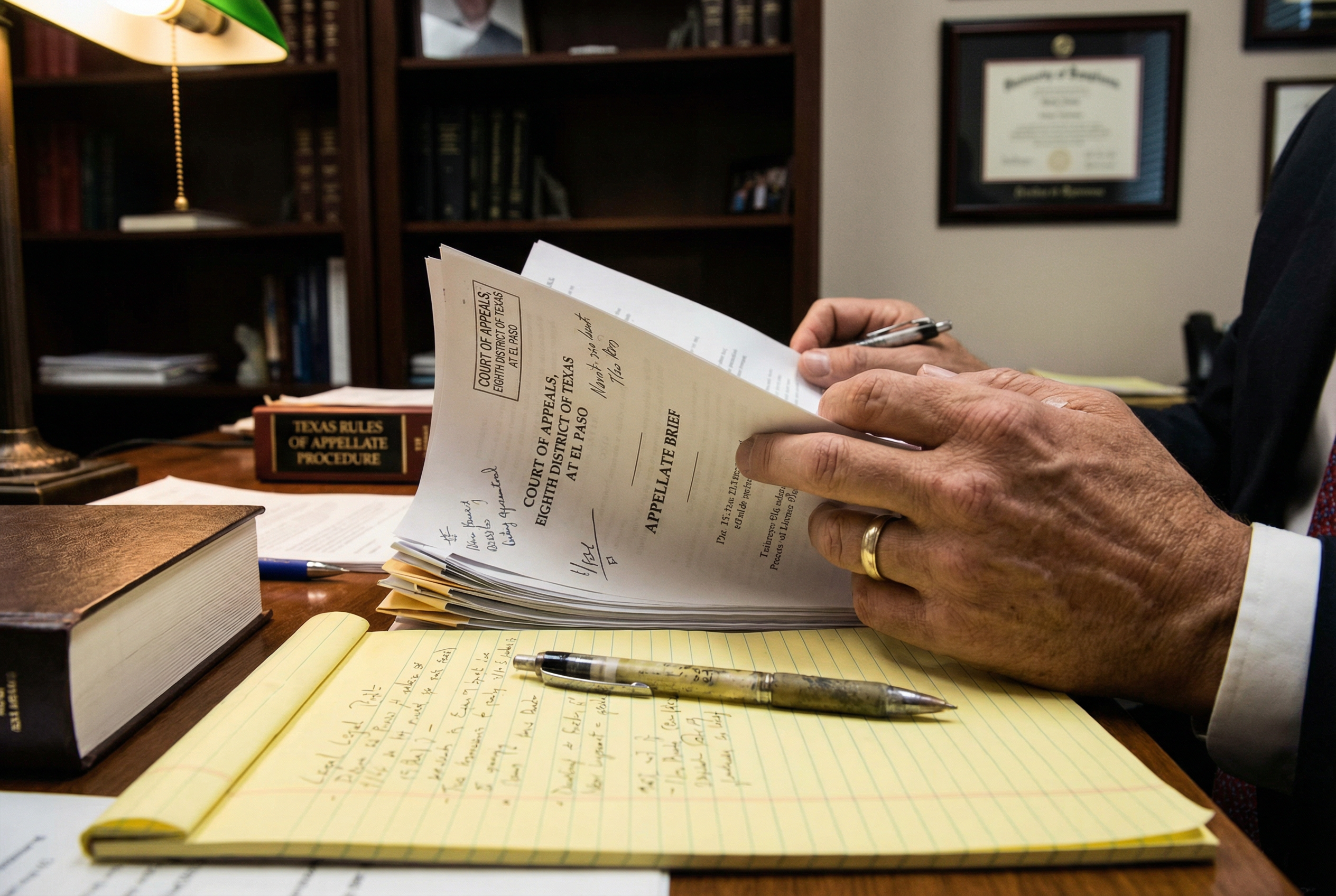
Frequently Asked Questions About Criminal Appeals & Post-Conviction Relief in El Paso
Related Charges & Defenses
Related Practice Areas
Official Resources
A conviction is not the end of the road.
The Texas Eighth Court of Appeals in El Paso has reversed convictions and reduced sentences in cases where the right arguments were made at the right time. Call Aaronson Law Firm at (915) 533-0110 today for a free, confidential consultation about your appeal. Time is critical — do not wait.
Available 24/7 for urgent matters · 45+ years defending El Paso residents